Wed, Thu, Fri, Sat: 9am - 6pm
.jpg)
Hearing Aid Evaluations in Freehold, NJ
Independent, doctoral-level hearing aid consultations — Honest clinical guidance to help you find the right hearing technology for your specific hearing loss, lifestyle, and budget.
Hearing Aid Evaluations

At Haynie Audiology, our hearing aid evaluations are designed to help you find
the right hearing technology that is appropriate for your individual hearing
loss, lifestyle, communication needs, and personal preferences.
During your appointment, we review your hearing test results, discuss the
environments where you experience the
most difficulty, and explain the different hearing aid styles, features, and levels of technology available. The goal is to help
you make an informed, confident
decision and select hearing devices that support clearer communication, comfort,
and long-term hearing wellness.
Why a Professional Hearing Aid Evaluation Changes Everything
Hearing aids are available over the counter at pharmacies, electronics stores, and online retailers for a few hundred dollars. For a small percentage of patients — adults with mild, symmetrical hearing loss who are comfortable self-managing a consumer device — OTC hearing aids may be appropriate.
For most patients, they are not. Here is why.
A prescription hearing aid evaluation performed by a Doctor of Audiology is a clinical assessment. Before a single hearing aid is recommended, Dr. Haynie reviews your complete audiogram to understand the exact type, degree, and configuration of your hearing loss — sensorineural, conductive, or mixed — across every frequency that matters for speech understanding. OTC devices cannot be customized to your audiogram. They apply a generic amplification profile to ears that have a specific, individual pattern of hearing loss — which is why many patients who try OTC devices find them uncomfortable, tinny, or ineffective.
The difference between an OTC hearing aid and a prescription device fitted and verified by an audiologist is not primarily about hardware — it is about the clinical process that surrounds it. That process is what determines whether a hearing aid actually helps.
Read our blog here on the differences between prescription hearing aids vs. OTC devices

What to Expect — Your Hearing Aid Evaluation
A hearing aid evaluation at Haynie Audiology typically takes 60 to 90 minutes and covers every factor that determines which hearing technology is genuinely right for you. We review your insurance benefits before the appointment so you know exactly what coverage you have.
Here is what happens during your evaluation:
Audiogram Review — Understanding Your Specific Hearing Loss
Your evaluation begins with a thorough review of your audiogram results. If you do not yet have a recent hearing test, we will perform one at the same appointment. Dr. Haynie will walk you through exactly what your results mean — which frequencies are affected, by how much, and how your specific hearing loss pattern impacts your ability to understand speech in different listening environments.
This is the foundation everything else is built on. A hearing aid recommendation that does not start with a precise understanding of your audiogram is not a clinical recommendation — it is a guess.
Lifestyle Assessment — Where You Struggle Most
Hearing loss looks different in every patient's daily life. The audiogram tells us what you cannot hear. Your lifestyle tells us what that means for you.
During this conversation Dr. Haynie will ask about the specific situations where you find listening most difficult. Work meetings? Family dinners? Phone calls? Noisy restaurants? One-on-one conversation in a quiet room? The television? A retired patient who spends most of their time in quiet, low-demand environments needs a very different solution than a teacher managing a classroom, a professional spending hours on phone calls, or an active adult who entertains frequently. Your lifestyle is the clinical context that shapes which technology is genuinely appropriate — not just which technology is most advanced.
Technology Selection — Matching the Right Device to Your Life
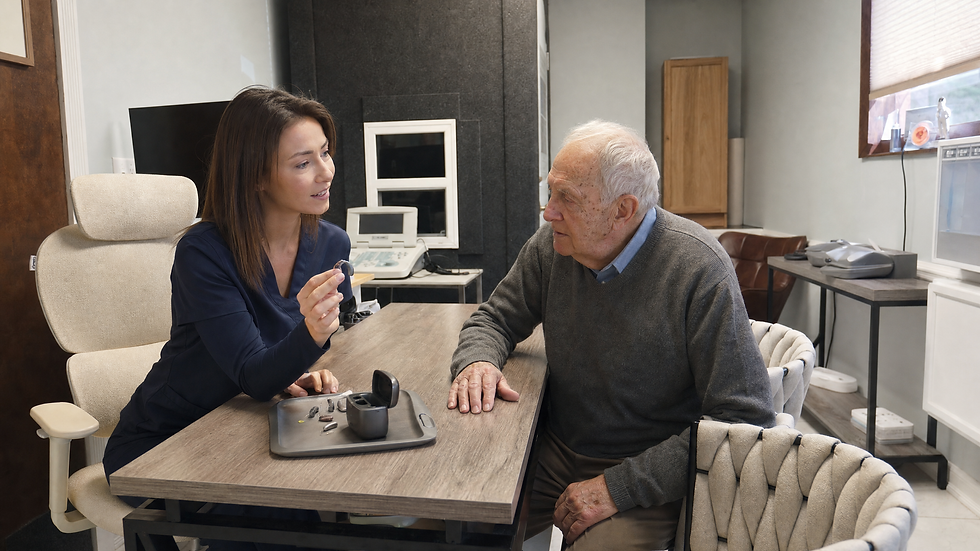
Once your audiogram and lifestyle picture is complete, Dr. Haynie will walk you through the hearing aid options most appropriate for your specific situation — explaining the differences between technology levels, form factors, and features in plain language, not technical jargon.
Technology tiers: Hearing aids range from essential-level devices designed for straightforward listening situations to advanced AI-powered platforms with dedicated speech separation processors, integrated health monitoring, and connectivity features. The right tier is the one that matches the complexity of your daily listening demands — not necessarily the most expensive one.
Form factors: Receiver-in-canal, completely-in-canal, in-the-ear, behind-the-ear. Each has clinical indications based on your degree of hearing loss, ear canal anatomy, dexterity, and aesthetic preference. Dr. Haynie will explain which options are appropriate for your specific audiogram.
Brands we carry: At Haynie Audiology we work with the leading prescription hearing aid manufacturers — Oticon, Phonak, Starkey, Signia, and Widex — and fit all current technology levels from each. We have no manufacturer affiliation, no preferred vendor relationships, and no incentive to recommend one brand over another. Our recommendation is based entirely on your audiogram and your life.
Current flagship devices we fit include the Phonak Audéo Infinio Ultra Sphere — HearAdvisor's independently verified #1 for speech in noise — the Oticon Intent with its 4D sensor technology and 4.9/5 HearAdvisor score, the Starkey Omega AI with fall detection and integrated health monitoring, the Signia Pure Charge&Go MaX with its four dedicated AI networks, and the Widex Allure with ZeroDelay PureSound processing. Every recommendation is explained in full so you understand exactly why a particular device is being suggested for your specific situation.
The Hearing Aid Trial Period
Selecting hearing aids is a significant decision — clinically, practically, and financially. You should not have to commit without the opportunity to experience how they actually perform in your daily life.
Every hearing aid we fit comes with a trial period during which you can wear your devices in every environment that matters — your workplace, your kitchen, your regular restaurant, your place of worship — and return for adjustments as your brain and ears adjust to amplification. If after the trial period the devices are not meeting your needs, we work with you to find a solution. Our goal is that you leave with hearing aids that genuinely help, not hearing aids that end up in a drawer.
Why the Fitting Process Is as Important as the Device You Choose
A hearing aid evaluation leads directly to a fitting appointment — and the quality of that fitting determines whether the device you selected actually performs the way it is capable of performing.
At Haynie Audiology, every fitting includes real ear measurement verification — a best-practice procedure in which a thin probe microphone is placed at the eardrum to confirm the hearing aids are delivering precisely the right amplification for your specific ear canal anatomy. Fewer than one in five audiology practices performs real ear measurement routinely. Without it, hearing aids are programmed to manufacturer defaults — generic settings that are rarely optimal for any individual patient's ear.
This matters more than most patients realize. The difference between a hearing aid programmed to manufacturer defaults and the same device verified with real ear measurement is often the difference between a device that helps and a device that gets returned or abandoned. The fitting protocol is what converts clinical technology into real-world benefit.
Learn more about our hearing aid fitting and verification process →
Independent Practice — What That Means for Your Recommendation
Haynie Audiology is an independently owned, single-provider doctoral-level audiology practice. We are not part of a corporate hearing center chain, not affiliated with any hearing aid manufacturer, and not incentivized by preferred vendor programs.
At large corporate hearing center chains, audiologists and hearing instrument specialists may operate under sales volume requirements, manufacturer incentive programs, or preferred product agreements that influence which devices are recommended to patients.
At Haynie Audiology, Dr. Haynie's recommendation is based on three things: your audiogram, your lifestyle, and the published clinical evidence for the devices available. That is the entire basis for every recommendation made in this practice.
If you have previously received a hearing aid recommendation at a chain location and want a second opinion from an independent audiologist — we welcome that conversation.
Insurance and Hearing Aid Benefits
Many patients are surprised by how much their insurance plan covers toward hearing aids. At Haynie Audiology we verify your insurance benefits before your evaluation so you understand exactly what is covered — including dollar allowances, eligible brands, and any requirements specific to your plan.
We accept Medicare and most major insurance plans. Coverage varies significantly by plan. Some provide a fixed dollar allowance toward any device. Others designate specific brands or technology tiers. Some managed care plans and third-party hearing benefit administrators such as TruHearing, HearUSA, and Amplifon have specific contracted rates and eligible devices. We are familiar with these programs and navigate them with you.
Financing is available for patients whose out-of-pocket costs exceed what their insurance covers. We can discuss financing options at the evaluation appointment.
Prescription hearing aids from the leading manufacturers typically range from $2,000 to $7,000 per pair depending on technology level and brand. No two patients pay the same amount because no two patients have the same insurance situation, the same degree of hearing loss, or the same technology needs. The evaluation appointment is the right place to get clarity on your specific costs.
Read our blog about understanding and maximizing your insurance benefit in Monmouth County
What to Bring to Your Appointment
-
Your insurance card and any hearing benefit documentation
-
A list of current medications
-
Any prior audiogram results or hearing test records — even from years ago
-
Your current hearing aids if you wear them
-
A family member or trusted companion if possible — two sets of ears for the discussion are genuinely helpful
No referral is required to schedule a hearing aid evaluation at Haynie Audiology.
Serving Freehold and Monmouth County
Haynie Audiology & Hearing Associates is located at 31 West Main Street in downtown Freehold — serving patients from Manalapan, Marlboro, Howell, Middletown, Hazlet, Aberdeen, Red Bank, Old Bridge, and communities throughout Monmouth County.
Or call: 732-810-2104