.jpg)
Why Can I Hear But Not Understand Words?

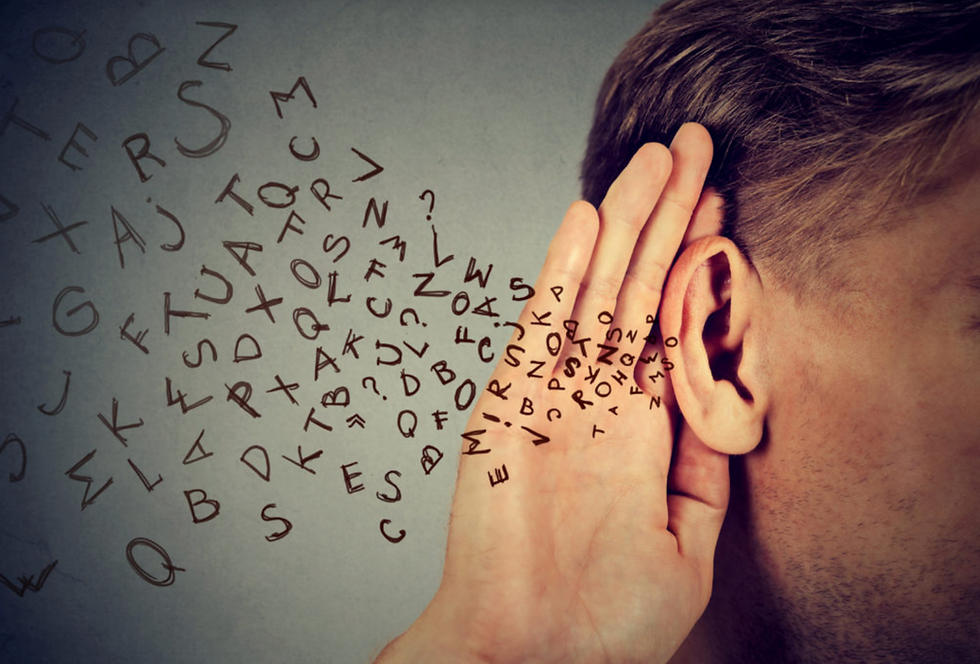
"I can hear you fine — I just can't make out what you're saying." It is one of the most common things said in an audiology office, and one of the most misunderstood. Many people assume that if they can hear someone talking, their hearing must be fine, and that the real problem is something else — mumbling, background noise, or simply not paying close enough attention. In a meaningful number of cases, the real explanation is a specific and well-understood pattern of hearing loss that has nothing to do with volume at all.
Hearing Speech Is Not the Same as Understanding Speech
Human speech is built from two broad categories of sound. Vowel sounds — A, E, I, O, U — are lower in pitch, carry most of the energy and loudness of speech, and are what gives you the sensation that someone is talking. Consonant sounds — S, F, TH, SH, CH, K, P, H, and others — are higher in pitch, much quieter, and carry the specific information that distinguishes one word from another.
This is the part most people never learn: the loudness of speech and the clarity of speech come from two different parts of the sound spectrum. You can hear that someone is speaking — because the vowels are loud and low-pitched — while losing the consonants entirely, because they sit in a higher frequency range your ear no longer picks up efficiently. The result is exactly the experience so many people describe: speech is present, a voice is clearly there, but the specific words are not.
High-Frequency Hearing Loss — The Most Common Cause
The most frequent explanation for this exact complaint is high-frequency hearing loss — a pattern where hearing remains relatively normal in the lower pitches but declines in the range roughly between 2,000 and 8,000 Hz, which is precisely where consonant sounds live. It is the single most common form of hearing loss, typically caused by the natural aging process, cumulative noise exposure over a lifetime, or both.
Picture a printed page where every S, F, TH, SH, CH, K, P, and H has been erased, leaving only the vowels behind. You could still tell that the page contains words. You would still recognize that it is, in fact, language. But you would not be able to reconstruct many of the actual words, and entire sentences would lose their meaning. That is a reasonably accurate picture of what high-frequency hearing loss does to spoken conversation — and it explains why words like "cat" and "hat," or "fifteen" and "fifty," become genuinely difficult to tell apart, even though the listener has no trouble noticing that someone is talking.
This is also why background noise makes the problem dramatically worse. In a quiet room, context and familiarity can sometimes fill in a missing consonant or two. In a restaurant, in a car, in a crowd — where competing noise masks the same high-frequency information that is already hard to hear — the gaps multiply and conversation can become exhausting to follow.
When the Audiogram Looks Normal But Speech Still Isn't Clear
There is a more subtle version of this problem that deserves real attention, because it can be missed by a basic hearing screening. Some people report genuine, persistent difficulty understanding speech — especially in background noise — even when a standard hearing test comes back within normal limits.
Ongoing research into a phenomenon known as cochlear synaptopathy, sometimes informally called "hidden hearing loss," suggests that damage to the connection between the inner ear's hair cells and the auditory nerve can degrade speech-in-noise understanding even when the ear still responds normally to quiet pure tones in a standard test. A standard audiogram measures whether you can detect a tone at a given pitch and volume. It does not, on its own, fully capture how well you can pull a specific word out of a noisy background. That distinction matters, and it is part of why a comprehensive evaluation includes more than a basic tone test.
It Isn't Always Hearing Loss — Sometimes It's the Brain, Not the Ears
There is a second, distinct explanation that produces a strikingly similar complaint: auditory processing disorder (APD). In APD, the ears themselves may be functioning normally — sound is detected just fine — but the brain has difficulty organizing, sequencing, or interpreting the auditory information it receives. A person with APD can have a completely normal audiogram and still struggle significantly to follow speech, particularly in noisy or fast-paced listening environments, particularly as a child in a classroom.
Because hearing loss and APD can produce nearly identical complaints — "I hear them talking, I just can't follow what they're saying" — they cannot be reliably told apart without professional testing. Treating one as if it were the other does not help, because the underlying mechanism, and therefore the appropriate intervention, is completely different.
Other Explanations Worth Ruling Out
Earwax buildup. Cerumen impaction can muffle and distort incoming sound in a way that mimics hearing loss, including the sensation of hearing someone speak without being able to make out the words clearly. A simple otoscopic exam identifies this immediately, and professional earwax removal can resolve it in a single visit — no hearing aid required.
Tinnitus. Persistent ringing, buzzing, or hissing can compete with and partially mask incoming speech, particularly the same higher-pitched consonant sounds that are already harder to hear. For some patients, tinnitus and the speech-clarity complaint are connected and need to be evaluated together.
Asymmetric or unilateral hearing loss. If the difficulty is more pronounced from one side, or seemed to begin somewhat suddenly, that pattern carries its own diagnostic significance and is worth flagging directly to an audiologist rather than assuming it is routine age-related change.
Why a Real Evaluation Matters More Than a Guess
Hearing fine but not understanding words is not a single condition with a single fix — it is a symptom with several genuinely different possible causes, each requiring a different response. A comprehensive hearing evaluation does more than confirm whether you can detect quiet tones. It documents your hearing across the full frequency range, specifically including the high frequencies where consonant clarity lives, and it includes speech recognition testing — measuring how well you can correctly identify words, not simply whether you can hear that a sound occurred.
That distinction between detecting sound and understanding speech is precisely the gap this entire complaint lives in — and it is exactly what a basic screening, an OTC self-test, or simply "seeing how it goes" cannot resolve. Guessing which of these explanations applies to you, and treating it accordingly without a diagnosis, is rarely a shortcut. It is usually just a delay.
If the Cause Is High-Frequency Hearing Loss
When high-frequency hearing loss is confirmed, modern hearing aids are specifically capable of amplifying the higher frequencies where consonants live, without over-amplifying the lower frequencies that are already coming through clearly — restoring the missing detail without making everything simply louder. Getting that balance right for your specific ears requires real ear measurement verification, a protocol that confirms the device is delivering the correct amplification at each frequency for your particular ear canal and audiogram, rather than relying on generic factory defaults. Fewer than one in five audiology practices use real ear measurement routinely — at Haynie Audiology it is included with every fitting as a clinical standard.
Get a Real Answer in Freehold, NJ
If you find yourself regularly saying "I heard you, I just didn't catch what you said," that pattern is worth taking seriously rather than working around indefinitely. At Haynie Audiology & Hearing Associates, Dr. Alexandra Haynie, Au.D., CCC-A, ABA provides comprehensive diagnostic evaluations — including full-frequency hearing testing and speech recognition assessment — to identify exactly what is behind your specific experience, whether that turns out to be high-frequency hearing loss, auditory processing disorder, earwax, or something else entirely.
No referral is required. Wednesday through Saturday appointments are available at 31 West Main Street in downtown Freehold, serving patients throughout Monmouth County. You do not have to keep guessing at conversations — you can find out exactly why they're hard to follow, and what to do about it.


Comments