.jpg)
What to Expect at Your First Hearing Test in Freehold, NJ
- Alexandra Haynie
- 6 days ago
- 5 min read

Updated: 6 days ago
Many people put off their first hearing test for years — not because they don't notice changes in their hearing, but because they're not sure what the appointment actually involves. If you're considering a hearing evaluation at Haynie Audiology & Hearing Associates in Freehold, NJ, here's exactly what to expect from start to finish.
Why Getting a Hearing Test Matters
Hearing loss is one of the most gradually developing conditions a person can experience. Because it happens slowly — often over years — many people adapt without realizing how much they've been missing. They turn up the TV volume a little louder, ask people to repeat themselves more often, or avoid noisy environments that used to feel comfortable.
A comprehensive hearing evaluation is the only way to know exactly where your hearing stands, what type of hearing loss is present (if any), and what options are available to you. The earlier it's identified, the more effectively it can be managed.
Haynie Audiology & Hearing Associates serves adults and children across Monmouth County, NJ, including Freehold, Manalapan, Marlboro, Howell, Middletown, and surrounding communities.
Before Your Appointment
You don't need a referral to schedule a hearing test at Haynie Audiology & Hearing Associates. You can book directly online or by phone.
Before your appointment, it's helpful to think about:
Any specific listening situations where you've noticed difficulty (conversations in restaurants, hearing on the phone, following along in group settings)
Any history of noise exposure (work environments, concerts, recreational shooting)
Current medications, since some can affect hearing
Any family history of hearing loss
Bring your insurance card if applicable, and arrive a few minutes early to complete any intake paperwork.
Step 1: A Conversation About Your Hearing History
Your appointment begins with a one-on-one conversation with Dr. Alexandra Haynie, Au.D., CCC-A, ABA. This isn't just administrative — it's clinically important.
Dr. Haynie will ask about your specific hearing concerns, how long you've noticed changes, your medical history, and your daily communication needs. Whether you're a teacher who needs to hear students clearly across a classroom, a parent trying to follow conversations at the dinner table, or a professional who spends a lot of time on phone calls, your lifestyle directly shapes the evaluation and any recommendations that follow.
This conversation also helps identify whether tinnitus (ringing or buzzing in the ears), fullness, or any other ear-related symptoms should be explored during the appointment.
Step 2: Otoscopy — A Look Inside Your Ears
Before any formal testing begins, Dr. Haynie will examine each ear canal using a handheld otoscope. This takes just a minute or two and checks for anything that might affect your hearing test results, such as earwax buildup, fluid in the middle ear, or any visible changes to the ear canal or eardrum.
If excessive earwax is present, it can temporarily affect hearing and may need to be removed before testing proceeds. Haynie Audiology offers professional earwax removal using microsuction and irrigation — a quick and comfortable procedure — right in the same visit if needed.
Step 3: Pure-Tone Audiometry — The Core of Your Hearing Test
You'll be seated in a quiet, sound-treated booth and fitted with headphones or small insert earphones. Through these, you'll hear a series of tones at different pitches and volumes — one ear at a time.
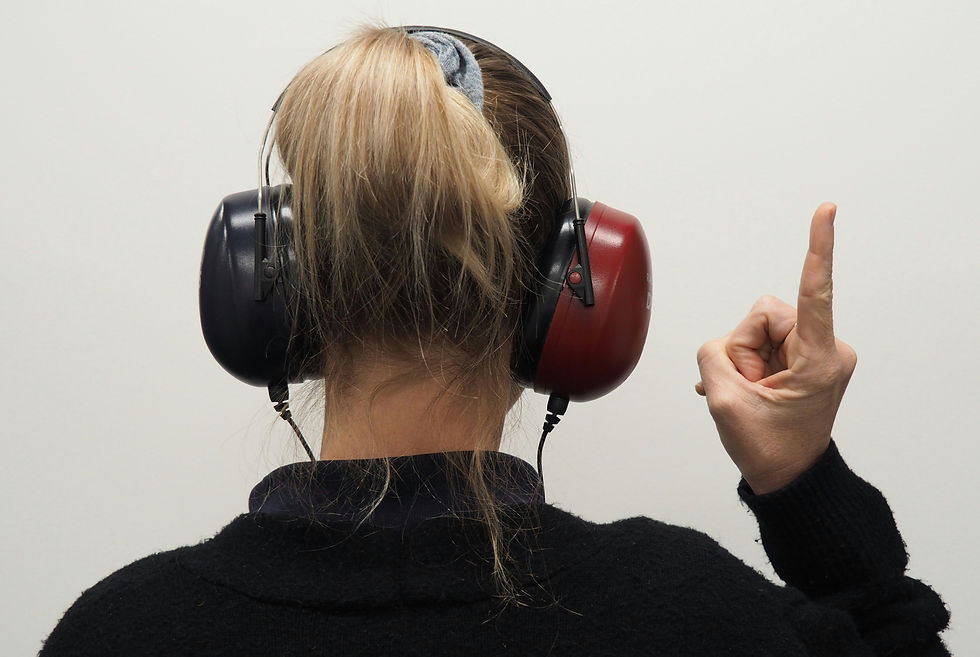
Your job is simple: press a button or raise your hand each time you hear a sound, even if it's very faint. The tones will vary in frequency (pitch) and intensity (loudness). This process maps out the softest sounds you can detect at each pitch for each ear, creating what audiologists call an audiogram.
Bone conduction testing may also be performed. A small vibrating device is placed behind the ear to assess how sound travels through the bones of the skull directly to the inner ear. This helps identify whether any hearing loss is located in the outer or middle ear, or deeper in the inner ear.
Step 4: Speech Testing
Hearing pure tones is only part of the picture. Speech testing evaluates how clearly you understand words — not just whether you can detect sound. This typically involves two measures:
Speech Reception Threshold (SRT)
The softest level at which you can correctly repeat back simple two-syllable words about half the time.
Word Recognition Score (WRS)
Words are presented at a comfortable listening level. You'll repeat each word back as clearly as you can. This score tells Dr. Haynie how well your ears process speech when the volume is sufficient — critical information when considering whether hearing aids would be beneficial and how much benefit to expect.
Step 5: Middle Ear Testing (Tympanometry)
In many evaluations, tympanometry is performed to assess how the middle ear is functioning. A small probe is placed gently at the entrance of the ear canal and creates a slight pressure change. The test is painless and takes only seconds. Tympanometry provides information about the eardrum's mobility and the health of the middle ear space, helping identify conditions like fluid, eardrum perforations, or Eustachian tube dysfunction that could be contributing to hearing difficulties.
Step 6: Reviewing Your Results — Together
One of the most important parts of your appointment happens right after testing: Dr. Haynie will sit down with you and explain your results clearly. You'll see your audiogram and learn exactly what the numbers mean for your everyday life.
If hearing loss is identified, Dr. Haynie will explain the type (sensorineural, conductive, or mixed), degree (mild, moderate, severe), and configuration (which pitches are affected). She'll also discuss what options are available — which may or may not include hearing aids, depending on your specific results and lifestyle.
There's no pressure and no rush. The goal is for you to leave the appointment fully informed and confident about your next steps.
How Long Does a Hearing Test Take?
A comprehensive hearing evaluation at Haynie Audiology & Hearing Associates typically takes 60 to 90 minutes, including the case history, testing, and results review. This is longer than a basic screening — and intentionally so. A thorough evaluation gives you and Dr. Haynie a complete picture of your hearing health, not just a pass/fail result.
Who Should Get a Hearing Test?
You don't need to be experiencing significant hearing loss to benefit from a hearing evaluation. Consider scheduling one if you:
Frequently ask people to repeat themselves
Have difficulty following conversations in noisy environments
Notice others seem to mumble
Turn the TV or phone volume higher than others prefer
Have ringing or buzzing in your ears (tinnitus)
Work in or have worked in loud environments
Haven't had your hearing checked in more than a year
Haynie Audiology also sees children ages 5 and up. Pediatric hearing evaluations follow the same thorough approach, adapted to each child's comfort level and developmental stage.
Schedule Your Hearing Test in Freehold, NJ
Haynie Audiology & Hearing Associates is located at 31 W Main Street, Freehold, NJ 07728, and serves patients throughout Monmouth County. No referral is needed. Appointments are available Wednesday through Saturday.
Ready to take the first step toward better hearing? Book your appointment online or give us a call — we're here to help.


Comments